
Paragon Perspectives | The Long Watch
Sometimes the Best Decision Is To Not Make a Decision
Main Points
- When everything looks great, that’s when we should be asking the toughest questions. AI’s long-term potential remains exciting, but popular investments can become expensive when investors start overlooking the risks.
- The market has a way of reminding us what we didn’t see coming. Growing regulatory concerns over AI infrastructure and NVIDIA’s unexpected leadership crisis show how quickly investors can reassess what they’re willing to pay for future growth.
- More investment decisions don’t necessarily mean better results. Reacting to every headline can create more opportunities to make mistakes. Sometimes the smarter approach is to evaluate what’s actually changed before deciding whether to act.
I doubt many investors had Jensen Huang’s sudden resignation as NVIDIA’s CEO on their 2026 bingo card. The debate over AI data centers, rising electricity costs, and local opposition to construction? That’s been going on for well over a year, and I wouldn’t expect it to settle down anytime soon. But losing the founder and longtime CEO of one of the world’s most influential tech companies amid a controversy involving possible foreign intelligence connections? That’s an entirely different kind of uncertainty.
Huang co-founded NVIDIA in 1993 and led it for more than three decades. His resignation follows reports involving a personal relationship and a woman suspected of ties to Chinese intelligence, prompting an investigation that raises serious questions about leadership, governance, and national security. These remain allegations, however, and the full implications are not yet known. NVIDIA’s longtime CFO, Colette Kress, has stepped in as interim CEO while the board searches for a permanent replacement.
It’s a significant development, and I don’t think investors should pretend otherwise. Huang was instrumental in building NVIDIA into one of the most influential tech companies in the world. His departure introduces uncertainties that deserve serious attention. However, there’s an important difference between something that deserves our attention and something that requires us to make an immediate investment decision.
And that brings me to something I’ve been thinking about quite a bit lately.
When AI Stocks Look Too Good to Go Wrong
Throughout much of this year, artificial intelligence was one of the most popular investment themes in the market. Companies supplying the chips, networking equipment, electricity, and infrastructure needed to power AI saw tremendous enthusiasm from investors. Many reported extraordinary growth, and expectations for future spending seemed to grow with every earnings announcement.
It wasn’t difficult to understand the excitement. AI has the potential to fundamentally change how businesses operate, and the amount of infrastructure required to support it is enormous. The problem comes when investors become so convinced of a promising future that they begin overlooking what could go wrong along the way.
I’ve always believed that one of the most dangerous times to make an investment is when it becomes difficult to imagine a reason not to make it. That’s often when expectations are highest, valuations are most demanding, and there’s very little room for disappointment. Ironically, it’s also when investors tend to feel the most comfortable putting their money to work. Nobody likes feeling as though they’re missing the next big thing. I touched on this back in August in Great Company, Bad Investment. A company can have tremendous prospects, but that doesn’t necessarily make its stock a good investment at any price.
Consider what’s happened to AI-related stocks since their highs over the summer and early fall. Semiconductor stocks, as a group, have experienced a substantial correction, while NVIDIA had fallen approximately 32% from its October 6 peak by November 13. Some of the companies most closely associated with the AI infrastructure buildout have experienced even sharper declines.
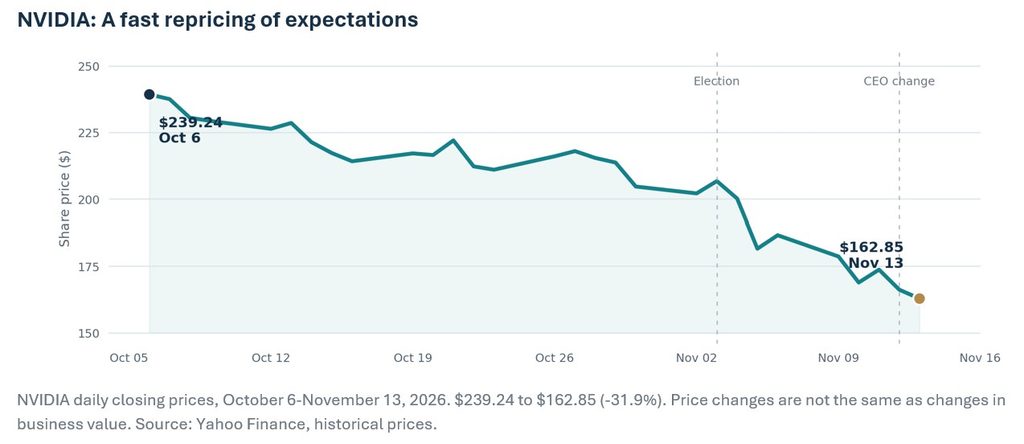
It’s not as though everyone suddenly stopped using AI. The underlying demand remains substantial, and many businesses continue reporting very strong operating results. What changed was investors’ willingness to pay increasingly higher prices for that growth, particularly as new risks emerged.
The November 3 midterm elections provided a good example. Democrats won control of both houses of Congress, flipped several governorships, and made significant gains in state and local elections. Throughout the campaign, many Democratic candidates criticized the rapid expansion of AI infrastructure and data centers, raising concerns about electricity costs, water consumption, and the impact these enormous projects could have on local communities.
Of course, none of those concerns are particularly new, and they aren’t entirely partisan, either. The debate over data-center construction has been growing for well over a year. Nobody gets particularly excited about a new data center moving into town if they believe it’s going to send their electric bill through the roof. The election didn’t create those concerns, but it did raise questions about how much more influence people opposed to rapid data-center expansion might have over future projects.
The election results increased the possibility of a more restrictive regulatory environment, particularly at the state and local levels where permitting and construction decisions are often made. Investors quickly began reassessing what slower project approvals, additional costs, or tighter regulations might mean for companies whose future earnings depend on building AI infrastructure as quickly as possible. Shares of several data-center-related businesses fell sharply, even as the broader stock market initially rallied following the election.
Importantly, the election didn’t suddenly make AI less useful, nor did it mean every proposed regulation would become law. But markets don’t wait for legislation to pass before adjusting expectations. They attempt to price in what might happen, and the possibility of slower growth can be enough to send a highly valued stock lower.
Then, just as investors were beginning to digest those developments, the NVIDIA headlines arrived. Another risk, one that few investors could have reasonably anticipated, had suddenly become very, very real.

The Problem With Making Too Many Investment Decisions
There’s a tendency in investing to associate activity with progress. The more we trade, adjust, reposition, and react to developments, the more it feels like we’re managing our investments better. I don’t blame anyone for thinking that way. Turn on CNBC on any given day, and you’ll probably hear someone discussing what they bought this morning, what they sold yesterday, and what they’re thinking about buying tomorrow.
But those traders aren’t necessarily investing for the same reasons our clients are. We’re not trying to win next week’s trading competition. We’re trying to help people accomplish financial goals that may be decades away. And unfortunately, making more decisions doesn’t necessarily mean we’re making better ones.
Every decision we make creates another opportunity to get something wrong. We might buy a popular company after a huge rally because we don’t want to miss out. Then, when the stock declines, we have to decide whether to sell, buy more, or wait for a recovery. If we sell and the price subsequently rebounds, we’re faced with yet another decision about whether to get back in.
One decision has now become three or four, and we need to get several of them right to improve our outcome. That’s a difficult way to invest, especially when we’re making those decisions in response to emotions rather than a thoughtful assessment of the underlying business.
This isn’t just my observation. Researchers Brad Barber and Terrance Odean examined more than 66,000 investment accounts and found that the households trading most frequently substantially underperformed the broader market. Their study carried the rather appropriate title Trading Is Hazardous to Your Wealth. While trading costs have declined considerably since that study, human nature hasn’t changed nearly as much. If anything, having the ability to trade from our phones at just about any time has made it easier than ever to confuse activity with progress.
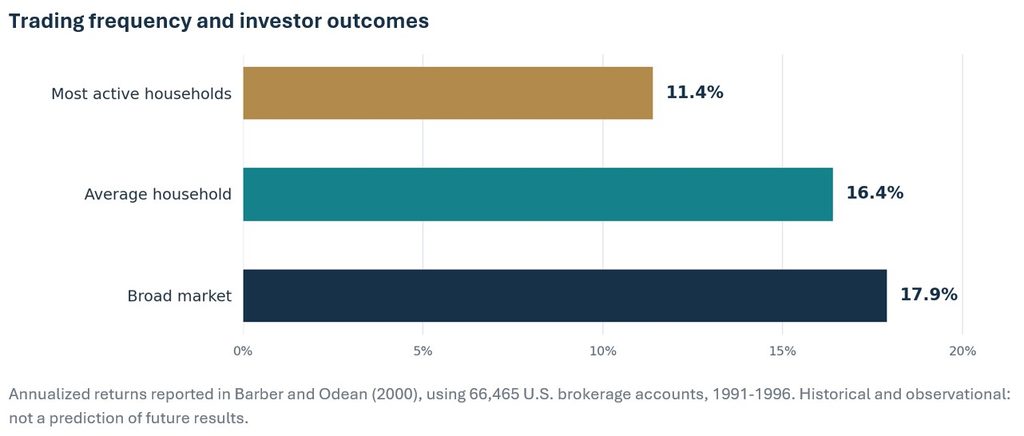
Now, I’m certainly not suggesting that investors should ignore bad news or hold investments indefinitely regardless of what happens. Sometimes the facts change, and a decision to make an adjustment is absolutely warranted. The challenge is determining whether we’re responding to a meaningful change in an investment’s long-term prospects or simply reacting to the discomfort of watching its price decline.
NVIDIA is a good example of why that distinction matters. The loss of Huang introduces legitimate concerns about the company’s long-term strategic direction, competitive position, and ability to maintain its remarkable pace of innovation. These aren’t risks that can simply be brushed aside. At the same time, NVIDIA still has thousands of engineers, an established software ecosystem, longstanding customer relationships, and years of product development behind it. Those capabilities didn’t disappear with Huang’s resignation.
The questions worth examining are whether the company can maintain its competitive advantages, execute its existing product roadmap, retain its engineering talent, and navigate any regulatory or operational consequences that emerge from the investigation. We also need to consider whether changes in data-center spending, competition, or financing costs could alter its longer-term prospects.
Those answers will become clearer over time. They won’t become clearer by checking the stock price every fifteen minutes.
Keeping Perspective
I remain very optimistic about the long-term potential of AI. But that doesn’t mean every company involved will be a success, or that their stocks will move straight up and to the right. Some of the biggest risks are the ones nobody seems particularly concerned about when everything is going well. That’s why I believe we should be asking the toughest questions when an investment is at its most popular, not just after its stock price has taken a beating.
I don’t know exactly how NVIDIA’s leadership situation will unfold, how much additional regulation AI infrastructure may face, or when the recent volatility will settle down. Anyone claiming to know the answers to those questions is giving themselves too much credit. What we can do is continue evaluating the facts, separating temporary setbacks from material changes in a business, and making adjustments when the evidence warrants them.
At Paragon, our clients are investing for goals measured in years and decades, not next Tuesday’s market close. We owe those goals thoughtful decisions, not a reaction to every headline. The objective isn’t to make more decisions. It’s to try to make the right ones when they matter. And sometimes, the best decision is to not make a decision at all.
Talk soon,
Ricardo J. Ferreira
Founding Partner & Portfolio Manager
About the Author
Ricardo J. Ferreira is the Portfolio Manager at Paragon Wealth, a firm he co-founded with Charlie McNamara, III, and Phil Rosenau. Drawing on his passion for finance and a talent for solving complex financial challenges, Ricardo leads the firm’s investment strategies, ensuring clients receive personalized and forward-thinking solutions.
A decorated U.S. Navy Veteran, Ricardo served at N.A.E.S. Lakehurst and aboard the USS George Washington, where he worked in aviation support. After his military service, Ricardo studied economics at Liberty University and began his financial career at Prudential Financial, where he met his future partners, Charlie and Phil.
Outside of work, Ricardo enjoys spending time with his family. He is married to Tina, partner in Paragon Accounting & Tax, and they have two children. Active in his community, Ricardo participates in various local events and serves on the finance council at St. Jude Parish in Chalfont. A passionate runner, he can often be found competing in local 5k and trail races on the weekends.
Sources & Further Reading
NVIDIA: Board statement on independent investigation (Nov. 8, 2026)
NVIDIA: CEO transition announcement (Nov. 12, 2026)
AP: 2026 congressional election results
Reuters: data-center stocks after midterms (Nov. 4, 2026)
Yahoo Finance: NVIDIA historical prices
Barber & Odean (2000): Trading Is Hazardous to Your Wealth
Disclosures
Ricardo J. Ferreira is solely an investment advisor representative of Paragon Wealth Management, and not affiliated with LPL Financial.
The opinions voiced in this material are for general information only and are not intended to provide specific advice or recommendations for any individual. All investing involves risk including loss of principal. No strategy assures success or protects against loss.
Advisors associated with Paragon Wealth Management may be either (1) registered representatives with, and securities offered through LPL Financial, Member FINRA/SIPC, and investment advisor representatives of Great Valley Advisor Group, or (2) solely investment advisor representatives of Great Valley Advisor Group, and not affiliated with LPL Financial. Investment advice offered through Great Valley Advisor Group, a registered investment advisor. Great Valley Advisor Group and Paragon Wealth Management are separate entities from LPL Financial.