
Paragon Perspectives—The Long Watch: A long-term view on markets, economics, and investing
Over the summer, the mood in the stock market has been driven more by strong corporate earnings and continued enthusiasm around the AI buildout than by Iran and oil prices. The rally has also broadened beyond just a handful of chip companies, with smaller companies, financials, industrials, and other areas of the market joining the party.
Naturally, when stocks are going up and the stories behind them sound increasingly exciting, it becomes a lot easier to convince ourselves that almost any price is reasonable. That’s usually when it becomes even more important to remember what we are actually buying when we buy a stock, how we determine what it is worth, and why even a great company can sometimes turn out to be a bad investment.
You guys know I like individual stocks. One reason is that I think it is easier to understand what you actually own. That can be especially helpful when markets get volatile. If we understand the businesses behind the ticker symbols, it becomes a little easier to separate a falling stock price from a deteriorating business.
Individual stocks also give us more control over how a portfolio is constructed. We can be selective about the quality of the companies we own, how much exposure we have to different industries, and where we are taking risk.
But before we go any further, I thought it would be helpful to answer a very basic question: What is a stock, really?
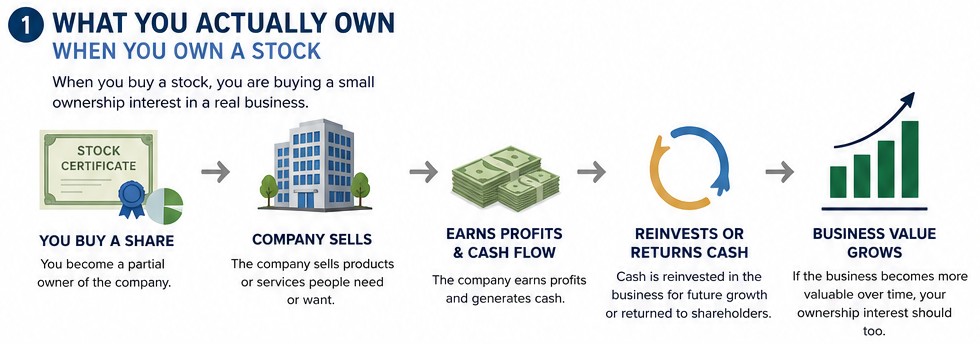
When you buy a stock, you are buying a small ownership interest in a real business. You aren’t simply buying a ticker symbol that moves up and down on a screen. You are becoming a partial owner of a company that hopefully sells products or services people need or want, earns profits, generates cash, reinvests some of that cash for future growth, and returns some of it to shareholders over time. If the business becomes more valuable over the years, your ownership interest should eventually become more valuable as well.
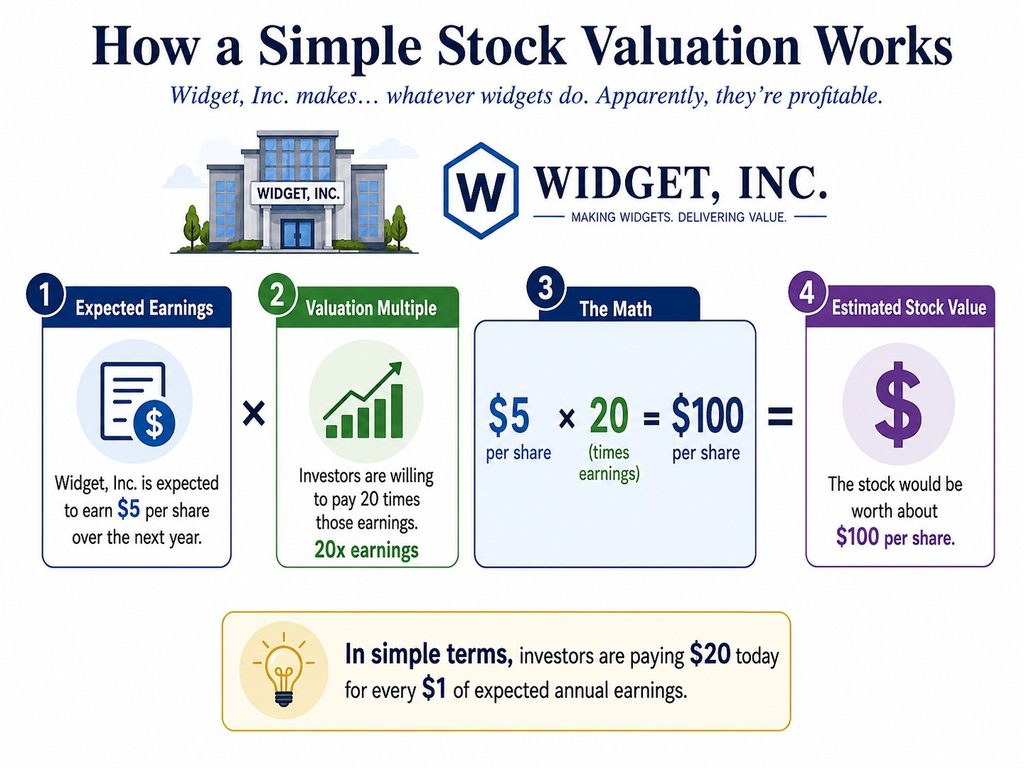
Of course, simply finding a great business isn’t enough. We also have to decide what that business is worth, and that can be one of the trickiest parts of investing. A company’s value ultimately comes from the profits and cash flows we expect it to generate in the future. Investors often simplify this by looking at how much they are willing to pay for each dollar of future earnings.
For example, let’s say you want to buy one share of a company we’ll call Widget, Inc. Widget makes whatever widgets do. Apparently, they’re profitable. If you believe Widget may earn $5 per share over the next 12 months and you are willing to pay 20 times those earnings, you would pay about $100 for one share.
Simple enough so far, right? But then comes the interesting part. Why would we pay 20 times Widget’s earnings? Why not 10 times? Why not 40? That’s where the real work comes into play.
Generally speaking, investors are willing to pay more for a company when they believe its earnings can grow faster, the business is high quality, management knows how to reinvest capital for future growth, the balance sheet is strong, and the company has some sort of competitive advantage that may allow it to continue growing for years. The hard part is trying to figure out what those future earnings may actually look like.
Will the company grow 5% per year? 10%? 30%? The more growth investors expect, the more they are usually willing to pay today. And when a lot of investors become convinced that a company has extraordinary growth ahead of it, valuations can rise very quickly.
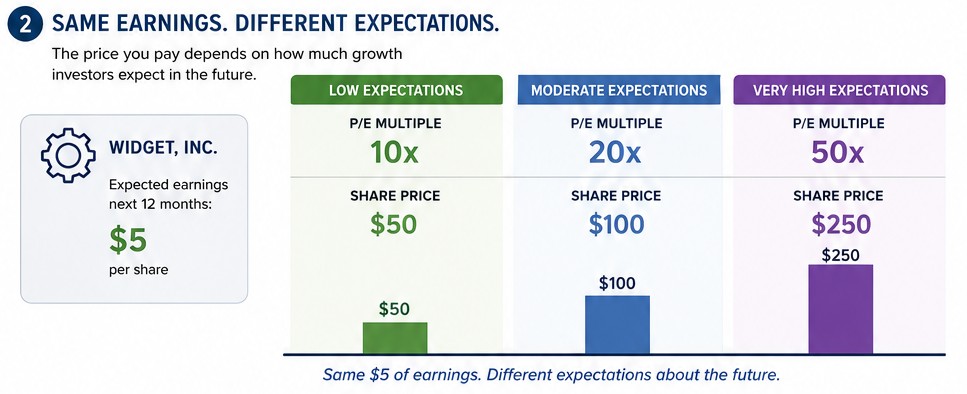
Going back to Widget, Inc., maybe investors decide those $5 of earnings deserve to be valued at 10 times earnings. Or 20 times. Or 50 times. At some point, the question changes from “Is this a good company?” to “How much of the good news am I already paying for?”
That distinction is important.
For instance, Tesla has recently traded at an extremely high multiple of expected earnings. At a valuation of 197 times earnings, at the time of writing, investors would effectively be paying $197 for every $1 of annual profit the company is expected to generate. If those earnings never grew, it would theoretically take 197 years of earnings to equal the price investors are paying today.
Of course, nobody buying Tesla at that valuation expects earnings to stay flat. Quite the opposite. The price reflects very high expectations for future growth. Tesla may very well grow into those expectations over time. The point is simply that investors are already paying for a lot of that future success today.
And that is really the lesson: The more you pay for a company today, the more that company has to deliver tomorrow.
So, now that we have Stock Valuation 101 out of the way, let’s move on…
We, as investors, are experiencing a once-in-a-generation period of investment in technology that may fundamentally change how we live and work. Let that sink in for a minute.
We’re talking about software that has the ability to hold a conversation with you about how to prepare an authentic Tuscan dish, cars that autonomously drive you to the store to buy the ingredients, and robots that may someday deliver pizza to you when you burn dinner because you were too busy reading about the economy instead of paying attention to the stove (not that I ever burn anything). That’s the world we may be living in very soon.
In the last few years, companies have spent enormous amounts of money building AI projects and infrastructure. Inevitably, when that much investment pours into one objective, demand for certain components and services becomes intense, and bottlenecks begin to form.
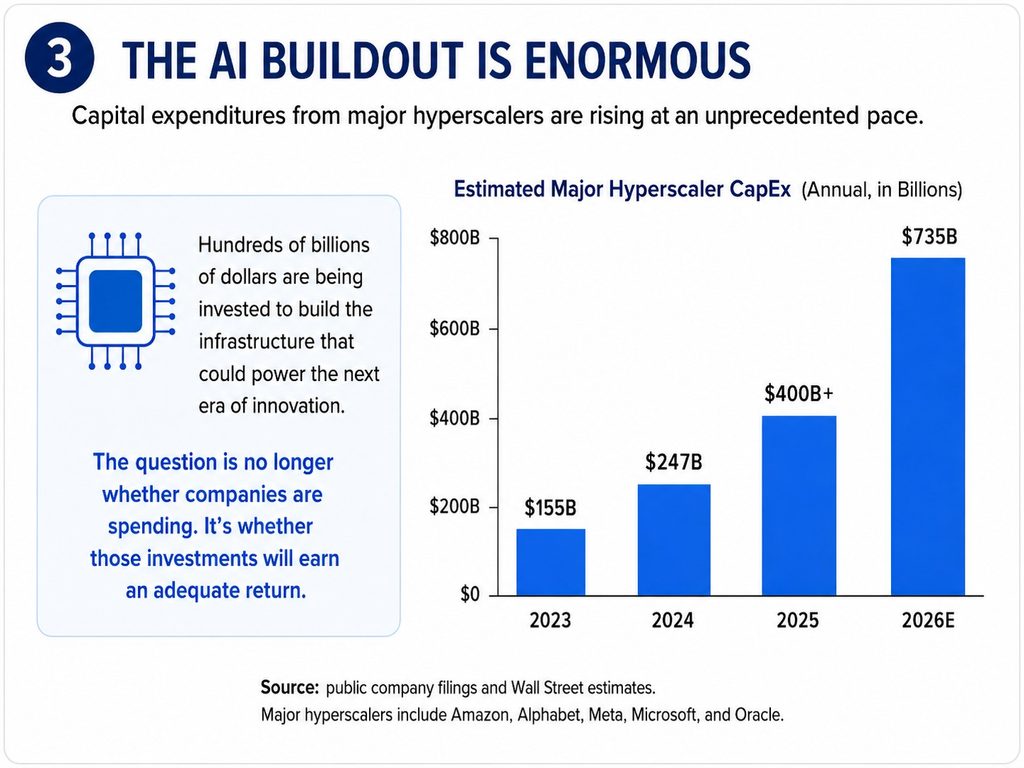
And this is where investing gets interesting.
When demand for something becomes scarce, the companies supplying it can experience explosive growth. Their earnings rise, their stock prices rise, and investors get very excited. Sometimes, a little too excited.
A great business isn’t always a great investment.
Case in point: Cisco Systems during the dot-com era. In the late 1990s, Cisco was one of the best companies in the world. It was growing fast, highly profitable, and selling the networking equipment that helped make the internet possible. Investors weren’t wrong about the importance of the internet, and they weren’t wrong about Cisco being a great business. Where they ran into trouble was the price they were willing to pay for it.
As enthusiasm around the internet grew, Cisco’s stock price rose much faster than the underlying earnings of the company. Investors weren’t simply paying for Cisco’s current profits anymore. They were paying for years and years of extraordinary growth that they assumed would continue well into the future.
That is where a great company can become a bad investment, and this is the part investors sometimes miss. When expectations get high enough, simply being a good company is no longer enough. The company has to be almost perfect. Earnings have to grow faster than expected, profit margins have to remain strong, competitors have to stay at bay, and many of the assumptions investors used to justify that high valuation have to play out pretty close to plan.
Cisco continued to be an important and profitable company long after the dot-com bubble burst. In the 10 years after 2001, Cisco’s revenues grew by 75%, and its net income grew by 209%.
Pretty nice, right? Except its share price lost about 46% of its value, falling from roughly $38 to $20 per share.
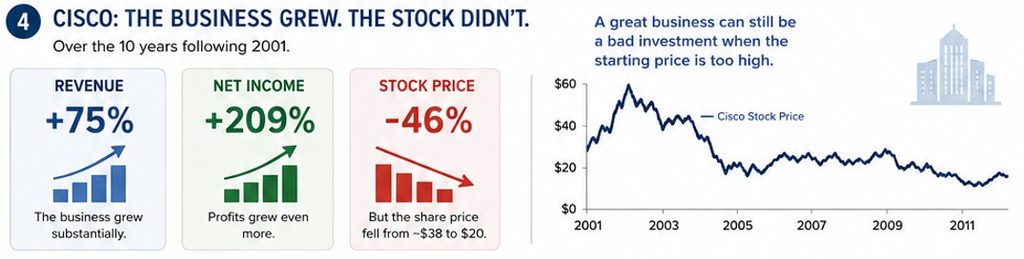
The business did quite well. The investment did not.
So why am I writing all of this?
Because we are living through one of the most exciting investment environments I can remember. There are extraordinary companies building extraordinary things, and some of them may ultimately become tremendous long-term investments. But excitement and valuation are two different things.
CEOs, analysts, and major investors certainly have not been shy about telling us how transformational all of this may be. And to be fair, they’re probably right. But our job as investors is not simply to identify which companies may benefit from AI. Our job is to determine how much of that future success is already reflected in the price we are being asked to pay today.
There are quite a few very good companies that have experienced tremendous growth because they are an integral part of the AI infrastructure story. Some you may already own in your portfolios, and some you may not.
Several clients have also asked us to buy certain companies for them or have told us about stocks they purchased in their own sandbox portfolios where they like to play around. We think that’s great. We love it when clients get excited about investing and want to participate in the process.
If there is a company you have heard about, read about, or are simply curious about, please let us know. We are always happy to do some research and help think through the business, the valuation, and even strategies for buying in when we believe the price may have gotten a little ahead of itself.
And there is one final part of this that I think is just as important. Sometimes discipline means passing on a great company because the price does not make sense. Other times, discipline means owning a good company through a difficult period because the business remains healthy and the long-term thesis has not changed.

Those two decisions may look completely different, but they come from the same place: understanding what we own, understanding what we think it is worth, and not allowing excitement or fear to make the decision for us.
Sometimes the smartest thing we can do is buy. Sometimes it is sell. And many times, after doing all the work, the best decision is to do absolutely nothing.
About Ricardo
Ricardo J. Ferreira is the Portfolio Manager at Paragon Wealth, a firm he co-founded with Charlie McNamara, III, and Phil Rosenau. Drawing on his passion for finance and a talent for solving complex financial challenges, Ricardo leads the firm’s investment strategies, ensuring clients receive personalized and forward-thinking solutions.
A decorated U.S. Navy Veteran, Ricardo served at N.A.E.S. Lakehurst and aboard the USS George Washington, where he worked in aviation support. After his military service, Ricardo studied economics at Liberty University and began his financial career at Prudential Financial, where he met his future partners, Charlie and Phil.
Outside of work, Ricardo enjoys spending time with his family. He is married to Tina, partner of Paragon Accounting & Tax, and they have two children. Active in his community, Ricardo participates in various local events and serves on the finance council at St. Jude Parish in Chalfont. A passionate runner, he can often be found competing in local 5k and trail races on the weekends.
Disclosures
The opinions voiced in this material are for general information only and are not intended to provide specific advice or recommendations for any individual. All investing involves risk including loss of principal. No strategy assures success or protects against loss.
The economic forecasts set forth in this material may not develop as predicted and there can be no guarantee that the strategies promoted will be successful. The prices of small and mid-cap stocks are generally more volatile than large cap stocks.
There is no guarantee that a diversified portfolio will enhance overall returns or outperform a non-diversified portfolio. Diversification does not protect against market risk. International investing involves special risks such as currency fluctuation and political instability and may not be suitable for all investors. These risks are often heightened for investments in emerging markets.
Securities offered through LPL Financial, Member FINRA/SIPC. Investment advice offered through Great Valley Advisor Group, a registered investment advisor. Great Valley Group and Paragon Wealth Management are separate entities from LPL.
Ricardo J. Ferreira is solely an investment advisor representative of Paragon Wealth Management and not affiliated with LPL Financial.