
A long-term view on markets, economics, and investing
Markets Often Recover Faster Than Fear Does
Everywhere we look, spring is starting to show up again. The grass is getting greener, the trees are blooming, the days are longer, and people are sneezing like it is an Olympic sport. Spring is supposed to be a season of renewal, when the darkness of winter starts to fade into the background. Lately, the market seems to be taking that same approach.
When Fear Peaked
On March 30th, the market hit its low for the year, falling almost 10% from its most recent high, and it seemed like the news was just getting worse. Oil was rising, the conflict in Iran was escalating, and, to top it off, TSA lines at the airport were taking hours to get through. Then, as the market tends to do, it saw the small but glittering light at the end of the tunnel and started its wall-of-worry climb back up. As I’m writing this note, the S&P 500 is only a few points away from an all-time high.
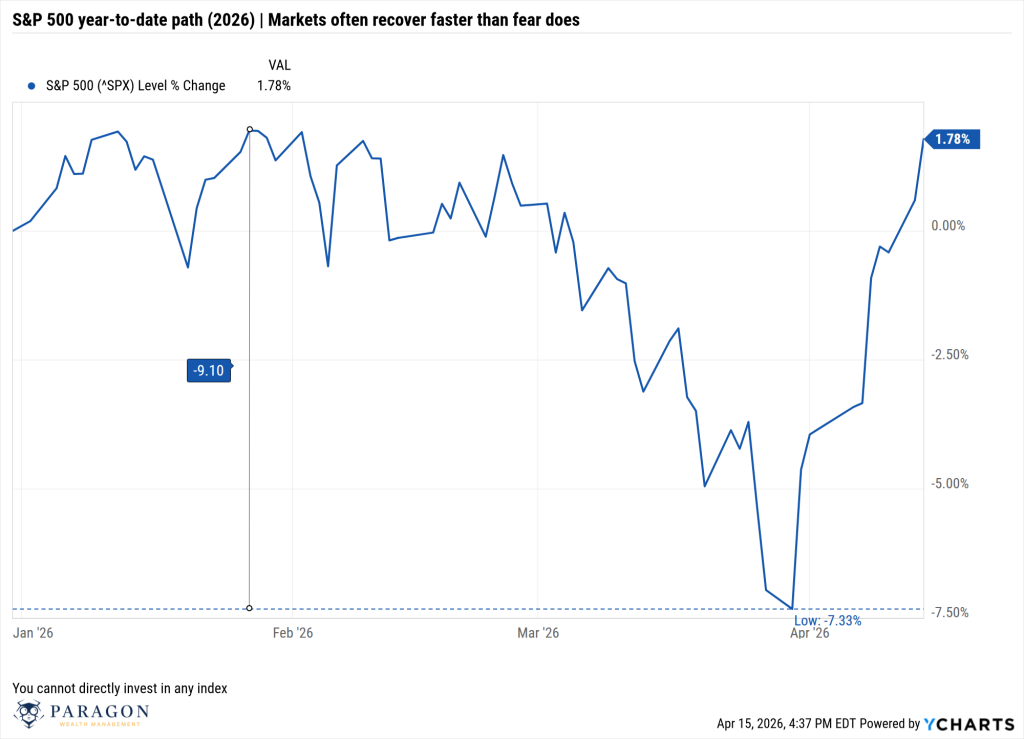
It’s often said that volatility is the price of admission to the long-term returns of the stock market, and we are reminded of this quite often. In fact, the market typically has pullbacks of 5% to 10% three times a year. Yes, you read that right. Luckily, as investors, we have short memories of these routine pullbacks, so we tend to forget how quickly they happen. One reason is that the market usually recovers within a month. That’s because the market rarely sends an all-clear signal. It just starts moving, usually while investors still feel uneasy.
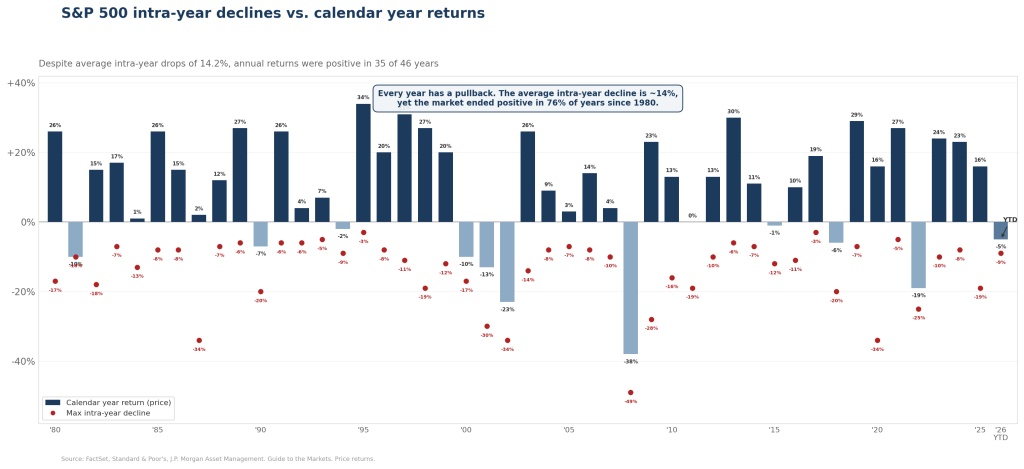
This decline felt particularly bad mainly because there were so many negative headlines that went along with it, and let’s be honest, military conflict, rising oil prices, and nonstop media coverage have a way of making every market move feel scarier.
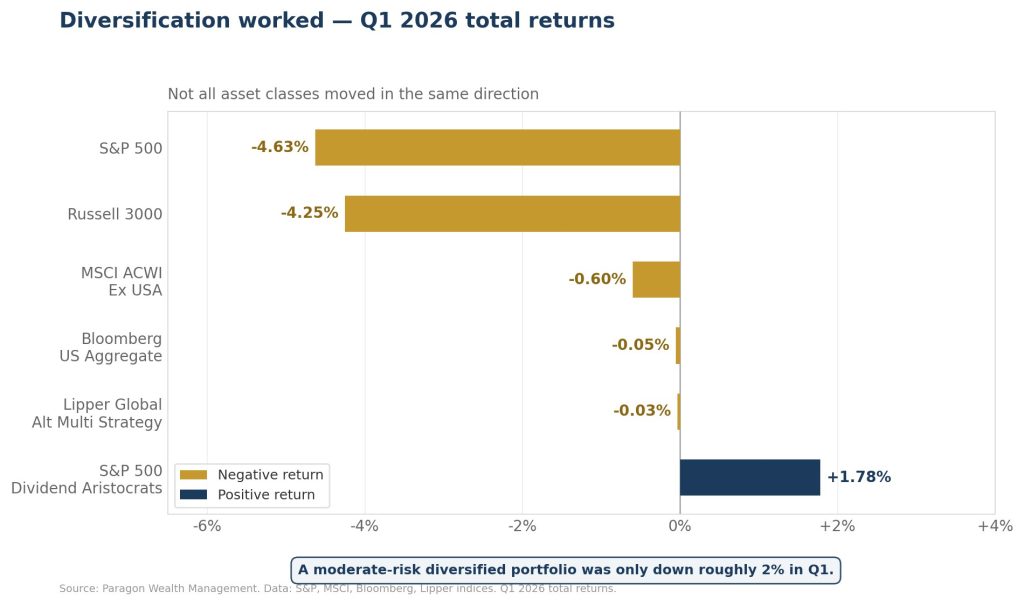
But fear not. Diversification worked.
Most of you are not aggressive investors. You’re working toward retirement or are already retired, so you’re not invested solely in stocks. And even if you are only in stocks, you’re not invested in just an S&P 500 index fund. That’s not how we roll. Most of you are invested in a diversified portfolio made up of individual companies that we believe will help shape and benefit from the economy ahead, bonds for stability and income, and liquid alternative funds that tend not to correlate with either the bond market or the stock market. As bad as the S&P 500 performed last quarter, small-cap stocks, international stocks, and dividend-paying stocks did not do as badly. In fact, the S&P 500 Dividend Aristocrats Index, which includes S&P 500 companies that have increased their dividends for the last 25 years, gained 1.78% in the first quarter, compared to the regular S&P 500 Index’s loss of 4.63%. If you were in a moderate-risk portfolio, chances are you were only down roughly 2%, thanks to the diversification of the portfolio.
What We Can Actually Control
For all you type-A personalities out there, let’s bring this back to something you can relate to: control. What can we control in times like these so we don’t make the mistake of selling on emotion and potentially locking in losses? Our process.
So, what’s our process? In the big picture, it comes down to diversification and quality. We want portfolios to be diversified, but not just for the sake of diversification. We want purposeful diversification. I don’t want to put something in the portfolio just because it’s different. I want it to complement something else, a zig for a zag, if you will. That’s why I pair bonds with certain liquid alternatives. They both have similar risk profiles as it relates to volatility, but because they are not the same asset, they can respond differently to the same catalyst, like a spike in interest rates.
When it comes to our process for selecting stocks, we also focus on things we can control:
• Quality: How much debt does the company have? Does it reinvest back into the business? Does it return money to shareholders through dividends or share repurchases? Does the management team have an owner’s mentality?
• Durability: Will this business be relevant long term? Is there a succession plan in place for management? Can I see a reason for cash flows to keep growing?
• Diversification: In selecting stocks, this is very important. You do not want to end up with a portfolio of companies that all move in the same direction all the time. A company like Axon Enterprises, which focuses on law enforcement systems and technology, is going to behave much differently than Constellation Brands, which sells beer and spirits, when the market is up or down.
Why Process Matters
Having a process helps a great deal when there is volatility in the market. All the pieces of the puzzle have a purpose and fit together so that, when the going gets tough, we don’t just throw out the pieces, because then it becomes harder to finish the puzzle. The lesson is not that markets are easy and we should just be on cruise control, because they are definitely not, and we definitely shouldn’t. The lesson is that having a disciplined process matters most when headlines are trying to convince you to abandon it.
As always, thank you for the trust you put in us. We know how important that is.
If you have any questions, you know where to find me in Doylestown. I’m always happy to talk about the markets and the economy, or as my wife calls it, the blah, blah, blah and the blah, blah, blah, and it gives me a reason to step away from my monitors. You can also visit our website, www.paragon-wealth.com and check out our library of articles. Phil’s recent one on the alternative minimum tax was a good one.
About Ricardo
Ricardo J. Ferreira is the Portfolio Manager at Paragon Wealth, a firm he co-founded with Charlie McNamara, III, and Phil Rosenau. Drawing on his passion for finance and a talent for solving complex financial challenges, Ricardo leads the firm’s investment strategies, ensuring clients receive personalized and forward-thinking solutions.
A decorated U.S. Navy Veteran, Ricardo served at N.A.E.S. Lakehurst and aboard the USS George Washington, where he worked in aviation support. After his military service, Ricardo studied economics at Liberty University and began his financial career at Prudential Financial, where he met his future partners, Charlie and Phil.
Outside of work, Ricardo enjoys spending time with his family. He is married to Tina, owner of Main Street Accounting & Tax, and they have two children. Active in his community, Ricardo participates in various local events and serves on the finance council at St. Jude Parish in Chalfont. A passionate runner, he can often be found competing in local 5k and trail races on the weekends.
Disclosures
The opinions voiced in this material are for general information only and are not intended to provide specific advice or recommendations for any individual. All investing involves risk including loss of principal. No strategy assures success or protects against loss.
The economic forecasts set forth in this material may not develop as predicted and there can be no guarantee that the strategies promoted will be successful.
There is no guarantee that a diversified portfolio will enhance overall returns or outperform a non-diversified portfolio. Diversification does not protect against market risk. International investing involves special risks such as currency fluctuation and political instability and may not be suitable for all investors. These risks are often heightened for investments in emerging markets.
Advisors associated with Paragon Wealth Management may be either (1) registered representatives with, and securities offered through LPL Financial, Member FINRA/SIPC, and investment advisor representatives of Great Valley Advisor Group, or (2) solely investment advisor representatives of Great Valley Advisor Group and not affiliated with LPL Financial. Investment advice offered through Great Valley Advisor Group, a registered investment advisor. Great Valley Advisor Group and Paragon Wealth Management are separate entities from LPL Financial. (next paragraph) All performance referenced is historical and there is no guarantee of future results. All indices are unmanaged and may not be invested into directly.
Alternative investments may not be suitable for all investors and should be considered as an investment for the risk capital portion of the investor’s portfolio. The strategies employed in the management of alternative investments may accelerate the velocity of potential losses.
Any opinions or views expressed by Ricardo J. Ferreira are his own and are not those of LPL Financial.
Ricardo J. Ferreira is solely an investment advisor representative of Paragon Wealth Management and not affiliated with LPL Financial.