
Paragon Perspectives: The Long Watch
A long-term view on markets, economics, and investing
Markets, Oil, and the Strait of Hormuz
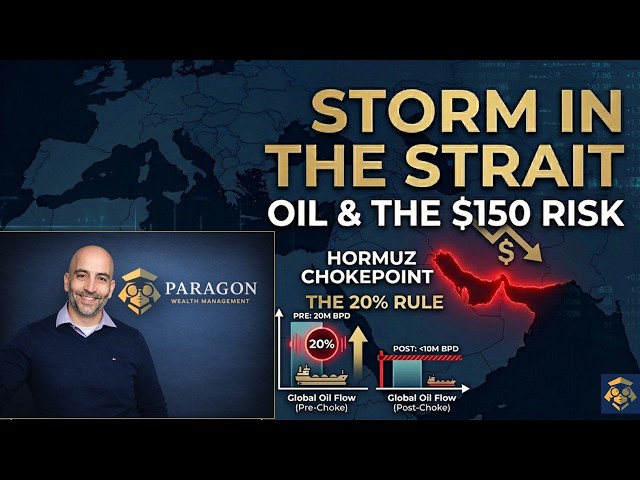
It seems like not a month goes by without some major event taking over the headlines. Last month it was the supposed demise of the software industry at the hands of artificial intelligence. This month it’s Operation Epic Fury and the sudden halt of tanker traffic through the Strait of Hormuz.
When events like this happen, markets tend to react quickly (and sometimes violently) as investors try to figure out what it all means for the economy and their portfolios.
In this commentary, I’d like to spend some time breaking down what’s actually happening in the Middle East, why markets have reacted the way they have, what it could mean for the global economy, and most importantly, what it means for you as an investor.
Fair warning: this one is a bit longer than usual… so buckle up.
Operation Epic Fury
Operation Epic Fury began on February 28th, when the U.S. and Israel launched coordinated strikes against Iran targeting military and missile infrastructure. Over 100 aircraft and sea-launched Tomahawk missiles targeted more than 1,000 sites in the first 24 hours. Reports confirmed the deaths of high-ranking military officials, including Supreme Leader Ali Khamenei.
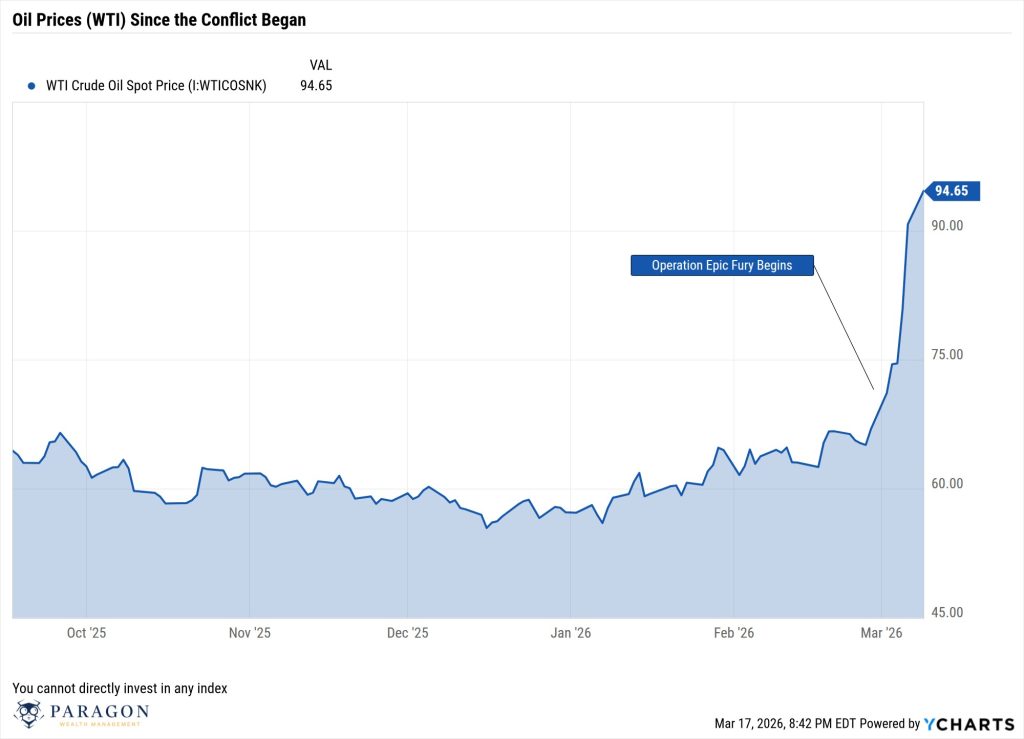
Since then, the U.S. has established local air superiority and effectively neutralized Iranian naval forces. The Strait of Hormuz is effectively shut down to commercial traffic, as Iranian sea drones have been targeting oil tankers, causing a spike in oil prices across the globe. Iran has also attacked several neighboring countries in retaliation, including the United Arab Emirates, Saudi Arabia, Bahrain, Kuwait, Iraq, and others.
Currently, the number of drone strikes by Iran has dropped by roughly 90%. Some analysts believe Iran may be running out of drones, while others suggest the country may be spacing out attacks in preparation for a prolonged conflict. The U.S. is also seeking international assistance to reopen the Strait of Hormuz to allow oil tankers to flow again.
Strait of Hormuz
The Strait of Hormuz is one of the world’s most strategically important choke points. It is a narrow waterway connecting the Persian Gulf to the Gulf of Oman and the Arabian Sea, measuring only about 21 miles wide at its narrowest point.
The strait has been a vital trade artery for millennia, serving as the primary link between the civilizations of the Middle East, India, and China.
• Antiquity: In the 4th century BCE, Nearchus, a commander for Alexander the Great, sailed through the strait to link the Indus Valley with Mesopotamia.
• The Kingdom of Ormus: From the 10th to the 16th century, the strait was controlled by the Kingdom of Ormus. It became one of the wealthiest ports in the world, serving as a hub for the spice trade, pearls from the Gulf, and silk from Persia.
• Colonial Era: Recognizing its strategic value, the Portuguese captured Ormus in 1507 to control the sea route to India. They held it until 1622, when a combined force of the English East India Company and the Safavid Empire ousted them, shifting control toward British and Persian interests.
In the 20th century, the importance of the strait shifted away from spices to energy following the discovery of oil in the Middle East. During the Iran–Iraq War in the 1980s, both nations attacked each other’s oil tankers in an attempt to disrupt their economies. The conflict escalated to the point that the U.S. Navy launched Operation Earnest Will, escorting Kuwaiti tankers to ensure the continued flow of oil.
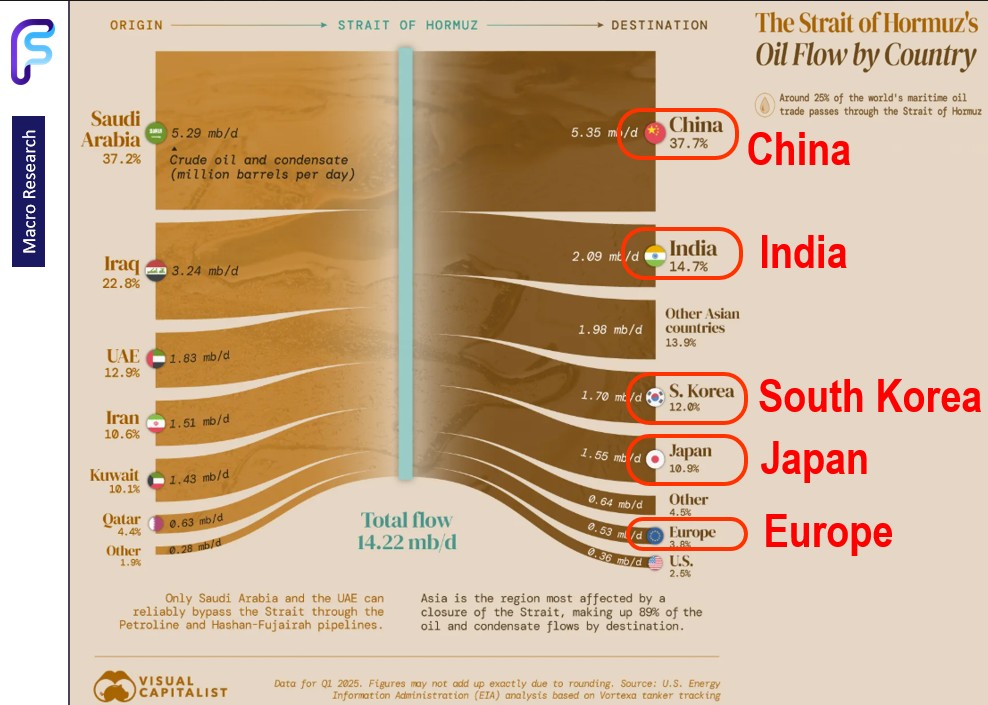
Before Operation Epic Fury, roughly 25% of the world’s maritime oil trade passed through the Strait of Hormuz. Asia is taking the brunt of the current supply disruption. Almost 90% of the oil that flows through the strait heads to Asia, with China leading the pack at nearly 40% of the flows.
All of this history points to one simple reality: when something happens in the Strait of Hormuz, the entire global economy feels it.
How Does This Affect You?
Besides the obvious fact that oil is in almost everything we use today, from gasoline to clothing, and that no one enjoys paying more at the gas pump than they have to, a prolonged period of higher oil prices would negatively affect inflation. With affordability already top of mind for most Americans, higher inflation is not something people want to deal with.
I’ve also heard many people say that this shouldn’t matter to the U.S. because we produce more oil than we use. Unfortunately, that’s not quite how it works.
The world operates on two prevailing oil prices: West Texas Intermediate (WTI) and Brent crude. In simple terms, you can think of WTI as U.S. oil and Brent as the rest of the world. While there is usually some price difference between the two, with WTI generally being cheaper, they tend to move in tandem. One reason is that oil companies cannot simply divert supply chains overnight. If there is a disruption anywhere in the global oil market, both prices tend to rise.
Another issue that affects the United States is that the Strait of Hormuz is also the world’s sulfur artery. The Gulf region produces roughly 44% of global seaborne sulfur, which is a byproduct of the oil and gas processing currently being disrupted by Operation Epic Fury.
Phosphate fertilizer cannot be produced without sulfuric acid. If sulfur exports become constrained, global phosphate production slows. This directly affects U.S. farmers who rely on phosphorus for root development during the corn planting season. Under-fertilization leads to lower crop yields per acre, which can lead to higher corn prices, which then raise feed costs, which ultimately pushes protein prices higher.
Higher inflation affects lower income families the worst, which is a population already hurting.
Are You Still With Me?
I know… that was a lot to take in. Congratulations, if you’ve made it this far! You now know more about the Strait of Hormuz than most people on TV.
By now, you can probably understand why markets have reacted the way they have. There is a lot at stake in that narrow strait, and markets today price in risks almost instantaneously.
Investors immediately reassess risks to oil supply, inflation, and global trade. Many of these reactions are now driven by automated trading systems that sell first and ask questions later. For this reason, markets often struggle during the military build-up phase, just before operations begin, and during the initial invasion.
This can create temporary price dislocations in markets that may present long-term opportunities for the right investors.
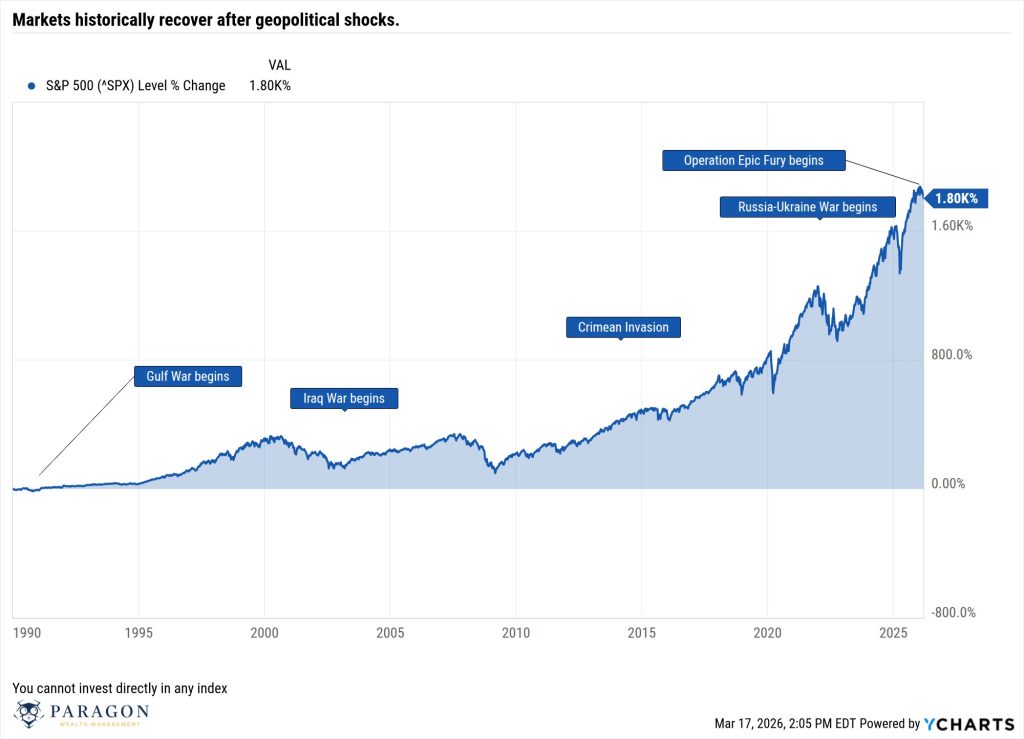
Once uncertainty stabilizes, markets tend to recover relatively quickly. Since the 1990s, after a geopolitical shock, the S&P 500 has historically been higher six and twelve months later. Emotional decisions during volatile periods can lead to permanent losses, which is why market timing rarely works.
So, What Actually Matters?
Instead of focusing on the rumor mill that often drives news headlines, let’s focus on what actually matters.
Oil Prices:
More specifically, how long oil prices remain elevated. Economies can withstand higher oil prices for short periods, but prolonged spikes can lead to higher inflation and slower economic growth. Ultimately, we want to see tanker traffic resume through the Strait of Hormuz.
Federal Reserve Reaction:
If oil prices remain elevated for an extended period, we will need to watch how the Federal Reserve responds. Realistically, the Fed has limited tools when dealing with a higher inflation, slower growth environment. Lower interest rates are not always the appropriate solution in such situations.
Inflation Expectations:
Sometimes expectations can be more dangerous than the original cause of inflation itself. If consumers expect higher prices in the future, they may accelerate purchases today. If enough people behave this way, it can increase demand in the present, encouraging companies to raise prices, which can create a self-reinforcing inflation cycle.
What Happens If the Strait of Hormuz Stays Closed?
This scenario is not my base case. There are many reasons why the U.S. administration would want to reopen the strait as quickly as possible. However, if the disruption were prolonged, here is how I believe markets could respond and how we are positioned.
Bonds
If oil prices remain elevated, particularly above $90 per barrel, inflation expectations may rise. That could push bond yields higher as investors anticipate tighter monetary policy. As yields rise, existing bonds decline in value. This is similar to what occurred in 2022.
In portfolios that contain bonds, we maintain an allocation to alternative investments. These investments tend to have low correlation to both stocks and bonds. Earlier this year, we increased our exposure to alternatives in anticipation that bond yields could drift higher. So far, that decision has worked in our favor.
Stocks
Stocks are more nuanced.
In his book Stocks for the Long Run, Professor Jeremy Siegel of the Wharton School argues that over the long term, stocks tend to be the best-performing asset class during periods of inflation. In the short term, however, they can be volatile. I encourage anyone who has the slightest interest in investing in stocks to read his book.
Stocks have what is often called a pass-through effect. As inflation rises, companies can increase the prices of their goods and services, which increases revenues and earnings.
In the short term, however, sustained higher energy prices would likely weigh more heavily on international markets than on the United States. The U.S. is a net exporter of oil, meaning Europe and Asia are typically more sensitive to sustained increases in energy prices.
In that environment, asset-light businesses (companies less dependent on energy-intensive operations) may fare better than cyclical industrial businesses.
Additionally, non-cyclical dividend-paying companies, such as consumer staples and healthcare businesses, have historically held up relatively well during uncertain economic environments.
The Dollar
While I don’t expect our clients to become currency traders, it’s useful to understand how the dollar may behave in such an environment.
If U.S. markets outperform international markets, global capital tends to flow toward the U.S., strengthening the dollar. The U.S. dollar is also traditionally viewed as a safe-haven currency during times of geopolitical stress. Proven once again by the current crisis.
A stronger dollar can sometimes weigh on gold prices. While gold is often discussed as an inflation hedge, I tend to view it more as a hedge against weakness in the dollar. The two do not always move together.

The Real Risk
Again, a prolonged closure of the Strait of Hormuz is not our base case, but it is a possibility we are watching closely. There is also a very real chance that tanker traffic resumes within the next week or two, which could quickly bring oil prices back down.
In that case, the opposite of everything discussed above could occur.
And therein lies the real risk.
Investing always involves uncertainty. We cannot control what will happen in the future. I can study the Strait of Hormuz until I’m blue in the face, military capabilities, geopolitical history, and human psychology, but that does not mean I will know exactly how governments will behave.
With that kind of uncertainty, the most important thing investors can do is understand what they own and why they own it.
What Are We Doing About It?
Our investment philosophy in stocks is simple: invest in high-quality businesses that benefit from long-term economic trends and hold them for a long time.
This philosophy works whether the Strait of Hormuz is open or closed.
The key question becomes: can the companies we own withstand an oil shock?
If a company has a strong balance sheet and sells goods or services that remain in demand, the answer is usually yes. If it cannot withstand that kind of environment, it likely should not be in the portfolio to begin with.
Recently, I made the difficult decision to remove a company from our dividend model because it had taken on more debt than I was comfortable with for a strategy designed to be defensive. I still believe the company will likely be worth more five years from now than it is today. But if I don’t follow the process, then the process itself has no value.
Why We Build Portfolios This Way
Periods like this are exactly why we build portfolios the way we do.
No one can predict geopolitical events, oil prices, or how markets will react in the short term. Anyone who claims they can is probably guessing.
What we can do is focus on owning strong businesses, maintaining diversification, and sticking to a disciplined investment process.
Markets have lived through wars, oil shocks, financial crises, pandemics, and countless other surprises. Yet over time, investors who remain patient and focused on long-term fundamentals have historically been rewarded.
Our job is not to predict every event that might happen in the world.
Our job is to build portfolios that can be resilient enough to endure them.
If you have any questions about how recent market volatility or geopolitical events may impact your portfolio, or if you’d like to review your investment strategy, please don’t hesitate to reach out. You can contact us directly or learn more about our approach at Paragon Wealth Management by visiting www.paragon-wealth.com
About Ricardo
Ricardo J. Ferreira is the Portfolio Manager at Paragon Wealth, a firm he co-founded with Charlie McNamara, III, and Phil Rosenau. Drawing on his passion for finance and a talent for solving complex financial challenges, Ricardo leads the firm’s investment strategies, ensuring clients receive personalized and forward-thinking solutions.
A decorated U.S. Navy Veteran, Ricardo served at N.A.E.S. Lakehurst and aboard the USS George Washington, where he worked in aviation support. After his military service, Ricardo studied economics at Liberty University and began his financial career at Prudential Financial, where he met his future partners, Charlie and Phil.
Outside of work, Ricardo enjoys spending time with his family. He is married to Tina, owner of Main Street Accounting & Tax, and they have two children. Active in his community, Ricardo participates in various local events and serves on the finance council at St. Jude Parish in Chalfont. A passionate runner, he can often be found competing in local 5k and trail races on the weekends.
Disclosures
The opinions voiced in this material are for general information only and are not intended to provide specific advice or recommendations for any individual. All investing involves risk including loss of principal. No strategy assures success or protects against loss.
The economic forecasts set forth in this material may not develop as predicted and there can be no guarantee that the strategies promoted will be successful.
There is no guarantee that a diversified portfolio will enhance overall returns or outperform a non-diversified portfolio. Diversification does not protect against market risk. International investing involves special risks such as currency fluctuation and political instability and may not be suitable for all investors. These risks are often heightened for investments in emerging markets.
Advisors associated with Paragon Wealth Management may be either (1) registered representatives with, and securities offered through LPL Financial, Member FINRA/SIPC, and investment advisor representatives of Great Valley Advisor Group, or (2) solely investment advisor representatives of Great Valley Advisor Group and not affiliated with LPL Financial. Investment advice offered through Great Valley Advisor Group, a registered investment advisor. Great Valley Advisor Group and Paragon Wealth Management are separate entities from LPL Financial. (next paragraph) All performance referenced is historical and there is no guarantee of future results. All indices are unmanaged and may not be invested into directly.
Alternative investments may not be suitable for all investors and should be considered as an investment for the risk capital portion of the investor’s portfolio. The strategies employed in the management of alternative investments may accelerate the velocity of potential losses.
Any opinions or views expressed by Ricardo J. Ferreira are his own and are not those of LPL Financial.
Ricardo J. Ferreira is solely an investment advisor representative of Paragon Wealth Management and not affiliated with LPL Financial.